
JHAH plastic surgeon helps toddler regain use of little finger with first known tendon surgery of its kind
Dr. Ayyappan Thangavel, a plastic surgery consultant at Johns Hopkins Aramco Healthcare, repaired a young boy’s severed flexor tendon after the injury was left undiagnosed for several weeks.
Faisal Al Ghamdi was little more than 18 months old when the accident happened. Roaming the kitchen, looking for mischief, he picked up a glass and fell. The glass smashed and Faisal cut the little finger on his right hand.
His parents took him to the local emergency room with what looked like a shallow cut. His wound was closed, his hand was covered in a big bandage, and he was sent home.
Three weeks later, when the bandage was removed, Faisal’s parents noticed that his little finger was awkwardly rigid, sticking out straight while his other fingers moved freely. It was clear that something was wrong.
Faisal was referred to Dr. Ayyappan Thangavel, a plastic surgery consultant at Johns Hopkins Aramco Healthcare (JHAH), who discovered that Faisal had severed two tendons in his little finger. The diagnosis was confirmed by a scan, and the doctor recommended that Faisal undergo corrective surgery.
“Dr. Thangavel was very honest with us,” Abdullah Al Ghamdi, Faisal’s father, says. “At that first meeting, he said there was no guarantee that surgery would be successful because Faisal was so young, and his hands were so small.”
Dr. Thangavel determined that Faisal had severed his flexor tendons, which control the movement of the little finger. “It’s a severe and unusual injury to have at that age,” the doctor says. “I hadn’t seen it before in my 30 years of practice.”
“For an adult, we would expect to conduct three surgeries over 18 months to repair this sort of injury. For this young child, we conducted a single-stage surgery to repair the damage in one go. It would not have been good for Faisal to have multiple surgeries under general anesthetic.”
One of the complications arising from an untreated severed flexor tendon is that the tendon retracts into the hand or forearm, and the various mechanisms supporting the tendon disappear over time. These mechanisms include the “pulleys” that help keep a tendon in place and apply force to joints, and the “tunnel” that houses the tendon. “These systems had disappeared from Faisal’s hand, so we used existing structures within the hand to recreate the pulleys and the tunnel,” Dr. Thangavel says.
For adult patients who undergo tendon reconstruction, surgeons typically seek to repair both the flexor digitorum profundus (FDP), which flexes all three finger joints, and the flexor digitorum superficialis (FDS), which flexes only the lower two joints.
“The space in Faisal’s little finger was very constrained, so to avoid unwanted damage, optimize results, and reduce the number of surgeries, we decided the best course of action was to only repair the FDP, and to suture that one tendon which controls all joints,” Dr. Thangavel says.
A single-stage repair involving the reconstruction of a secondary flexor tendon, pulleys, and tunnel in a child under the age of two has not previously been reported, according to an extensive search of medical literature and discussions with international specialists in the field.
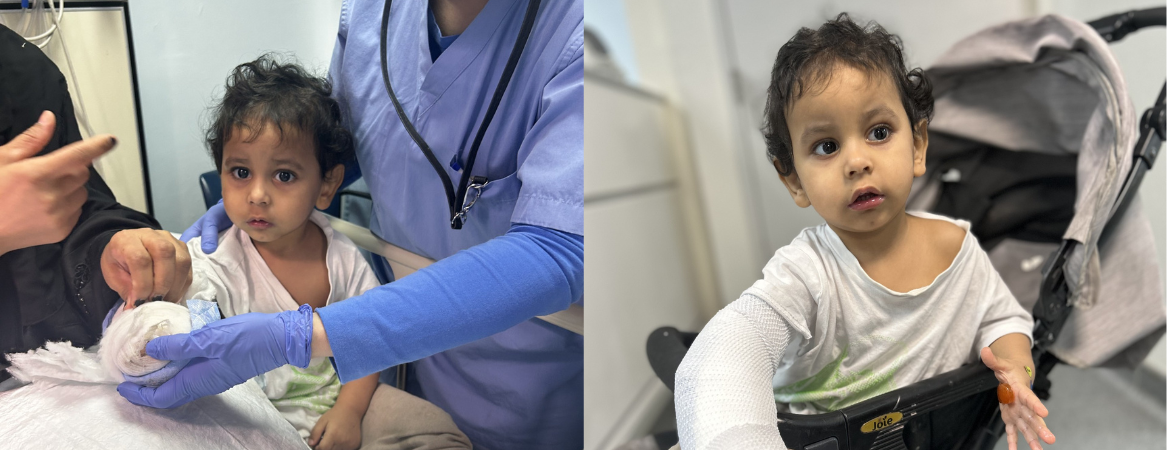
A few weeks after surgery, Faisal visited JHAH Dhahran for his first follow-up appointment.
“There was a wonderful moment when Faisal came to see me after surgery,” Dr. Thangavel says. “We had to remove his dressing, and I was worried this would be very hard, and potentially quite painful for the boy. But when I began to remove the dressing, he started to help me, and I let him take over. He was so brave; he didn’t cry.”
The surgery was successful: Faisal was able to move his little finger, if only a little. “The joint was very stiff because it hadn’t been used for so long, and the ligaments had weakened,” Dr. Thangavel says. “He had regained a basic grip function, but it was clear he needed a significant amount of physiotherapy if he was going to recover full movement.”
Faisal and his parents have continued to visit Dr. Thangavel and his team for physiotherapy and monitoring. “He is doing really well; we are seeing increased movement at every visit,” Dr. Thangavel says. “It will be a long recovery process, especially because Faisal is so young and has far more interesting things to do than physiotherapy, but he is making excellent progress. He’s a brave boy.”
More news
26 Nov, 2025
Robotic Surgery Gives New Lease of Life to Ulcerative Colitis Sufferer
12 Oct, 2025
Breast Cancer Survivor: ‘Screening Saved My Life’
30 Oct, 2025